

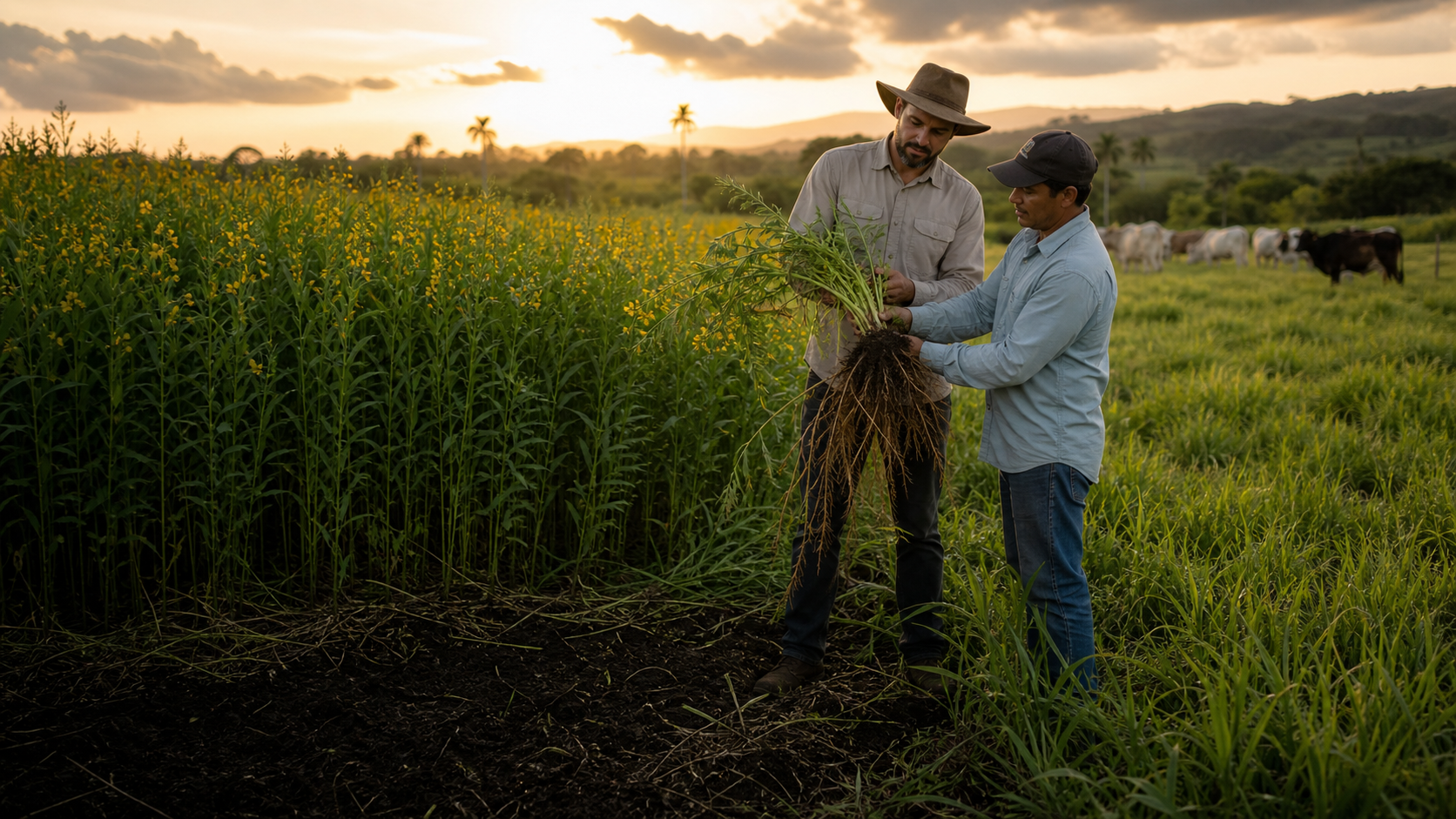
A farmer and agronomist inspect a rooted cover crop between a flowering field and productive pasture

Start with the field problem. Build the system around it

The right seed is not a stand-alone answer. It is a biological tool selected for a clear job, a real growing window and a result the farm can verify.

Explore seven solution pathways
A practical starting point

Seed becomes a solution when its role is specific

Fertility, pests, weeds, erosion and forage shortages do not begin with the same diagnosis—and they should not end with the same variety.

Tropical Seeds starts with the constraint, then matches plant function to climate, soil, crop sequence and management capacity. These seven pathways show what cover crops, forages and wildlife plantings can contribute, what management must deliver and what should be measured before the practice is expanded.

The problem we solve

Seven constraints. Seven different biological jobs

Choose the primary outcome first. Secondary benefits matter, but they should not blur the decision.

R
Nematode Control

Interrupt a known pest—not an unnamed category

Selected cover crops can act as poor hosts or help create suppressive rotations for selected plant-parasitic nematodes. The first step is always identification; a crop that reduces one species may host another.

Best starting point
Crescent Sunn™ in diagnosed warm-season rotations
Verify
Species-level assay before planting and after termination
W
Weed Suppression

Win the race for light, water and space

Rapid establishment, canopy closure and retained residue can reduce opportunities for weeds. Suppression depends on stand density, timing and biomass—not on seed presence alone.

Best starting points
Crescent Sunn™, Ruziziensis, Lablab and Pigeon Pea
Verify
Ground cover, weed density and post-termination emergence
S
Soil Restoration & Carbon Building

Return roots, cover and organic inputs to the field

Canopy protects the surface while roots explore the profile and feed soil biology. Repeated, well-managed cycles can improve aggregation, infiltration and organic-matter trends.

Verify
Cover, infiltration, aggregation and soil-carbon trend
F
High-Performance Forage & Grazing

Match forage potential to the animal and the harvest system

Variety defines a production envelope. Maturity, fertility, grazing pressure, cutting interval and conservation decide the yield and quality the animal actually receives.

Verify
Forage test, utilization, regrowth and animal response
P
Pasture Establishment & Renovation

Build the stand before asking it to perform

Water regime, shade, drought exposure and soil fertility separate the grass portfolio. Fine seedbed preparation, shallow placement and a protected first-use window determine whether that selection becomes a persistent pasture.

Verify
Plant density, anchorage, cover and recovery after first use
H
Wildlife Food & Habitat

Plant for a target species and a managed season

Wildlife plantings should match the target animal, feeding period, soil, plot size and local regulations. A productive food plot complements—not replaces—complete habitat.

Best starting points
Chufa for tuber-producing turkey and waterfowl plots, and Lablab for warm-season browse
Verify
Target use, plot pressure, seasonal availability and wildlife rules
From constraint to recommendation

A strong result follows a clear sequence

Diagnose

Define the primary constraint

Name the field, target, baseline and production consequence.

Select

Match function to environment

Use climate, soil, water, crop sequence and intended use.

Establish

Protect the biological tool

Calibrate seed, placement, timing and early competition.

Measure

Decide from field response

Track the outcome before changing inputs or expanding acres.

Bring us the problem

We will help define the job before naming the seed

Share the crop, location, growing window, water regime and primary constraint. Terra can narrow the starting options for a field conversation.