
Seed delivered
Identity, quality, lot and intended acres.

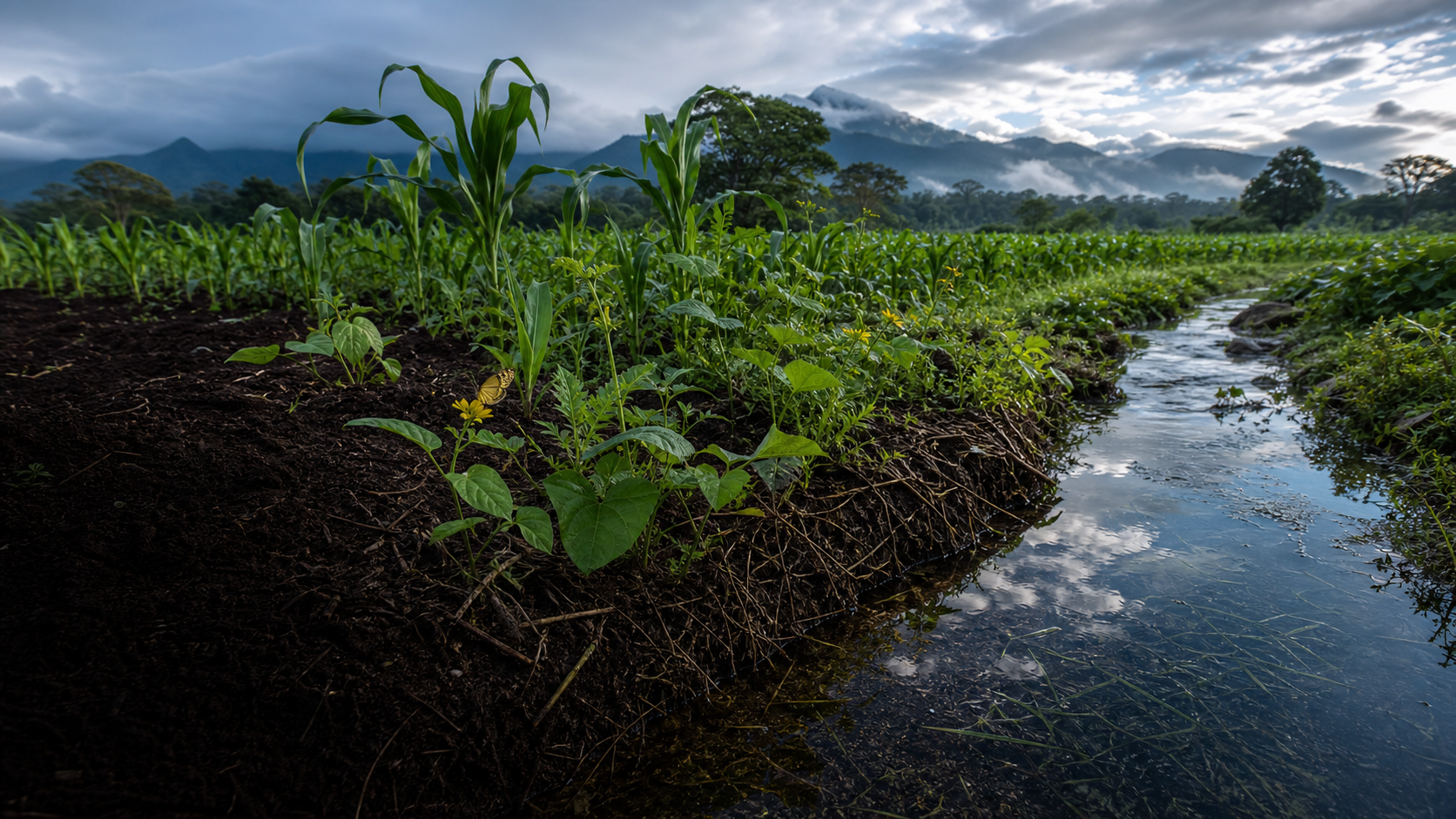
Seed enables a practice. Establishment, management and time create the outcome. Credible sustainability connects each step and measures what changes.
Explore five impact pathwaysA seed sale is not an environmental result. The field has to establish, perform its intended function and produce a measurable change against a useful baseline.
Tropical Seeds contributes adapted plant genetics and practical management guidance. Farmers, advisers, weather, soil and the rest of the production system shape the outcome. This framework keeps that shared contribution visible—and keeps every future impact claim tied to evidence.
Identity, quality, lot and intended acres.
Planting, establishment, duration and management.
Cover, biomass, roots, forage or pest response.
Change versus baseline, with time and boundary stated.
Living roots, canopy and residue extend the period when the farm captures sunlight and protects the soil. Repeated practice can improve biological activity, aggregation and resilience.
Photosynthesis moves carbon into shoots, roots and the rhizosphere. Biomass is an input; durable soil-carbon change depends on decomposition, disturbance, climate and repeated management over time.
Legume nitrogen, competitive canopy and selected pest rotations can reduce dependence on fertilizer, herbicides or nematicides in some systems. Substitution should follow diagnosis and field evidence, never a blanket promise.
Canopy softens raindrop impact, roots stabilize soil and residue slows surface flow. Better cover and structure can support infiltration, moisture retention and reduced sediment loss.
Drought-tolerant pasture, waterlogging-tolerant grass, shade-adapted groundcover and protected soil give the farm more ways to absorb heat, rainfall variability and seasonal feed gaps.
What condition or management practice are we comparing against?
Was the result measured, modeled or estimated—and how?
Which field, period, depth, input and production system are included?
What changed because of the practice, and what else influenced the result?
Define the baseline, select the plant function, record management and compare the result at the same place and time.