
Keep soil covered
Use canopy and residue to soften rain, slow runoff and reduce erosion.

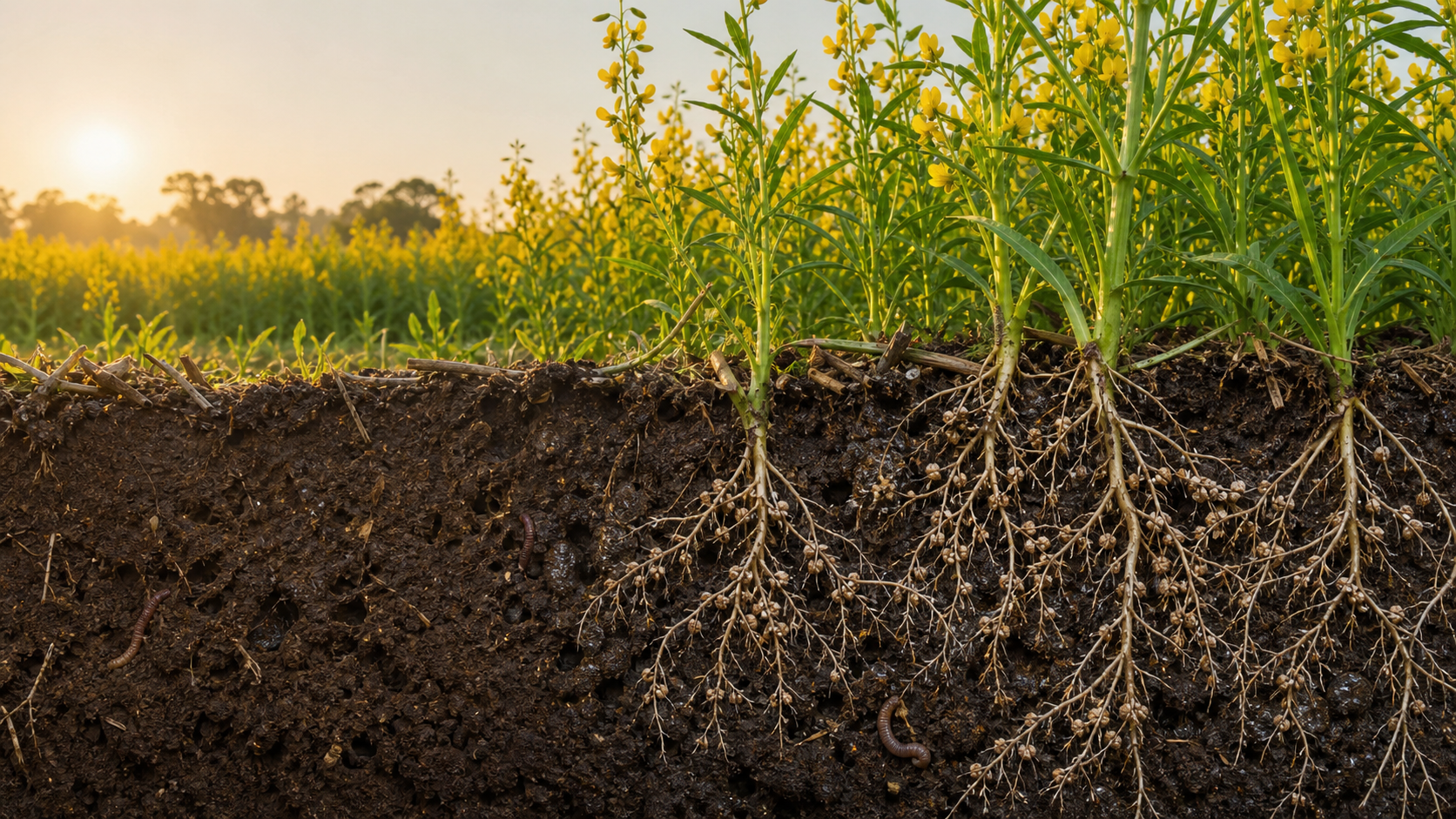
Rebuild soil function with living roots, protected ground, purposeful diversity and management that works with biology—not around it.
Explore the role of cover cropsAgriculture becomes regenerative when each management decision helps the farm recover more of its natural capacity to cycle nutrients, hold water, protect soil and support productive crops.
It is not one recipe, input or certification. It is an outcome-focused direction of travel: keep the soil protected, extend the time it carries living roots, build diversity into rotations, disturb it only as much as necessary and use every input with greater precision. The right choices vary by climate, crop, soil and farm objective; the common standard is measurable improvement over time.
Use canopy and residue to soften rain, slow runoff and reduce erosion.
Keep photosynthesis feeding the rhizosphere beyond the cash-crop window.
Choose species for distinct jobs and build a more resilient rotation.
Protect structure, pore space and the biological networks already at work.
Track field response and adapt the system instead of relying on assumptions.
Regenerative agriculture is the deliberate rebuilding of the biological and physical functions that productive farming depends on.
Conventional systems can become extractive when bare ground, repeated disturbance and simplified rotations remove soil function faster than it can recover. The regenerative direction asks a different question: how can the next crop be produced while leaving the soil better able to support the one after it?
This does not mean rejecting every modern input. It means rebuilding biological capacity so fertility and crop protection decisions can become more targeted, efficient and resilient. Progress is judged in the field—through soil cover, infiltration, root activity, nutrient cycling, pest pressure and crop response.
“The goal is not simply to use fewer inputs. It is to restore more of the work the farm can receive from living soil.”
A cover crop turns the space between cash crops into a period of active soil building.
Once established, its canopy intercepts rainfall and competes for light. Its roots hold soil, open pathways for air and water, and feed organisms in the rhizosphere. When the crop is terminated, roots and residue become a bridge that carries nutrients, carbon and protection into the next production cycle.
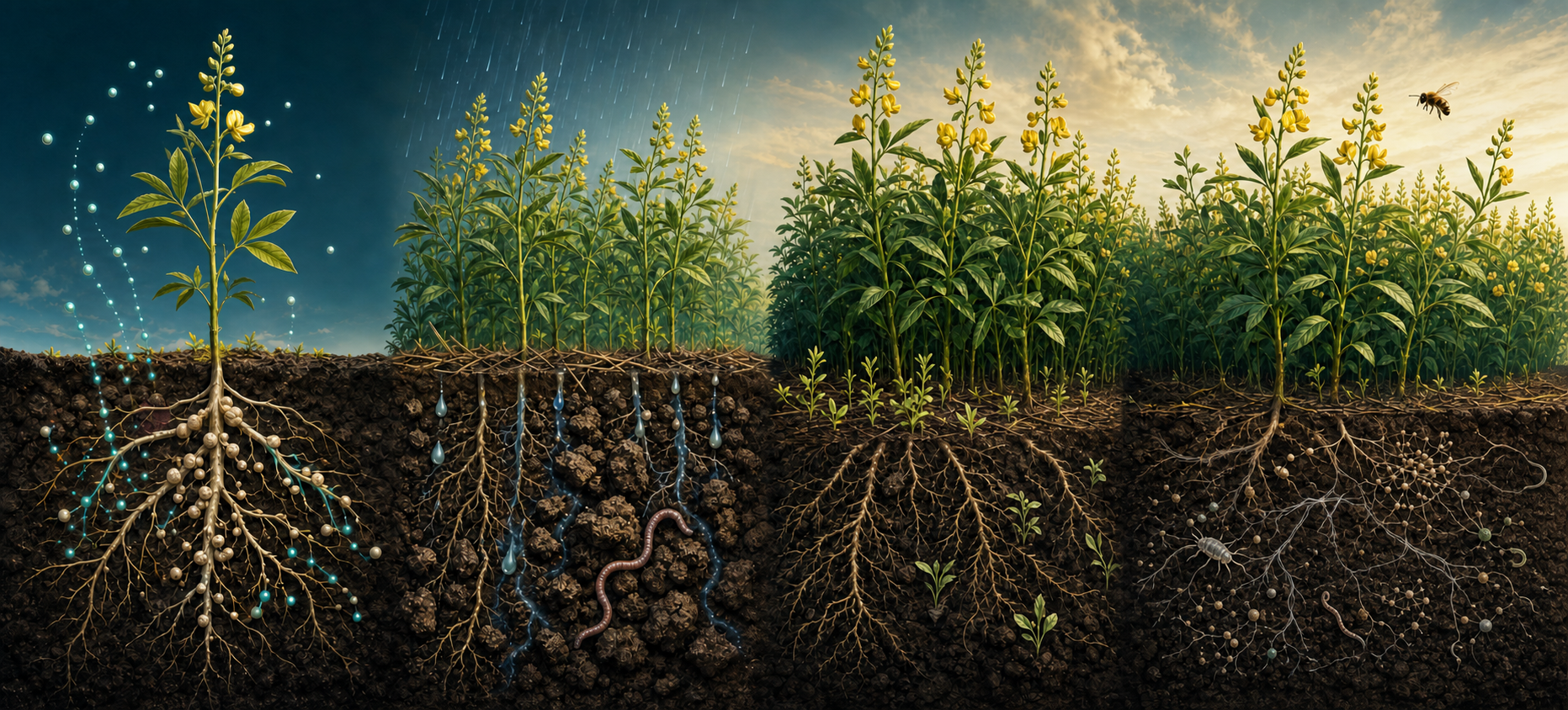
Legumes partner with rhizobia to convert atmospheric nitrogen into plant biomass. Termination timing and residue quality determine when that nitrogen becomes available to the next crop.
Canopy cushions heavy rain, roots anchor the surface and residue covers vulnerable ground while root channels support infiltration and structure.
Rapid establishment and dense biomass compete for light, water and space. Surface mulch can extend suppression after termination; allelopathic effects are species- and rotation-specific.
Selected cover crops can interrupt certain pest cycles, support beneficial organisms and reduce host opportunities. Nematode results depend on the species present and require diagnosis and monitoring.
The credible question is not, “Can seed replace chemistry?” It is, “Which biological functions can we rebuild, how much dependence can that reduce, and how will we verify the result?”
Cover crops and agrochemicals act on different timelines and through different mechanisms. A well-designed system may complement an input, partially substitute for it or reveal that direct control is still required. The decision begins with the field objective—not with an all-or-nothing promise.
| Field need | Direct-input route | Biological contribution | Management question |
|---|---|---|---|
| Nitrogen | Soluble fertilizer supplies a known dose on demand. | Legume fixation stores nitrogen in living biomass and residue. | Will release align with the next crop's demand? |
| Weeds | Herbicides target emerged weeds or prevent emergence. | Canopy, competition and residue reduce available light and space. | Can the cover establish before weeds gain the advantage? |
| Plant-parasitic nematodes | Nematicides provide targeted suppression within a defined window. | A poor-host rotation and suppressive residue may interrupt selected populations. | Which nematode species is present, and is the cover a poor host? |
Healthy soil is not simply soil with more material in it. It is soil whose living, chemical and physical processes work together.
Plants release carbon-rich compounds around their roots. These exudates support microbes that help transform nutrients and shape the immediate root environment.
Roots, fungal networks and microbial compounds help bind soil particles into aggregates. Stable pore spaces improve the movement and storage of air and water.
As roots and shoots decompose, soil organisms release nutrients back into plant-available forms. Species, maturity, moisture and termination all affect the timing.
A functioning soil food web includes bacteria, fungi, protozoa, beneficial nematodes and predators. The objective is ecological balance while specifically monitoring the plant-parasitic species that threaten the crop.
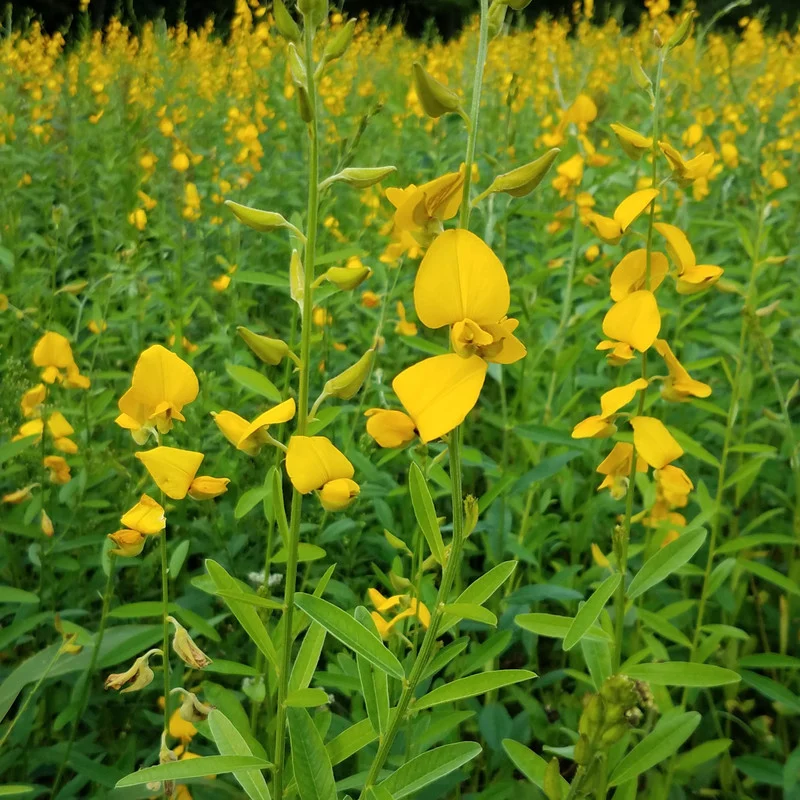
This fast-establishing sunn hemp was selected to build dense biomass in warm conditions, contribute biologically fixed nitrogen, compete with weeds and support a rotation strategy for selected plant-parasitic nematodes. The outcome still depends on establishment, timing, termination and the pressure present in each field.
Explore Crescent Sunn™Tell us the cash crop, climate, field window and primary challenge. We will help frame the cover-crop role before recommending a variety.